United Kingdom
From Themarshallwiki
(→Economy) |
(→Foreign Relations) |
||
| Line 141: | Line 141: | ||
=Foreign Relations= | =Foreign Relations= | ||
| - | Britain's closest relationships are with the Commonwealth, and with the | + | Britain's closest relationships are with the Commonwealth, and with the Federated States of America. In Europe, Britain has maintained the same foreign policy goal for over 900 years, to keep Europe disunited. There has been at times a Euro-federalist movement, however this movement has never gained significant support, and it must be noted that the two powers most likely to unite Europe are Fascist Germany, and the Soviet Union. Britain's allies in Europe consist of states like France, and some states in Eastern Europe. |
=Economy= | =Economy= | ||
Revision as of 23:38, 23 January 2009
| United Kingdom of Great Britain and Northern Ireland | |
| | |
 | 
|
| Flag | Royal Coat of Arms |
| | |
| Anthem God Save The Queen! | |
| | |
| |
| | |
| Capital Largest city | London London |
| | |
| Official languages | English |
| | |
| Government - Queen - Prime Minister | Constitutional Monarchy Queen Elizabeth II Chris Marshall |
| | |
| Establishment - Acts of Union - Act of Union - Anglo-Irish Treaty | 1 May 1707 1 January 1801 12 April 1922 |
| | |
| Area - Total - Water (%) | 244,820km2 94,526 sq mi 1.34 |
| | |
| Population - July 2007 est. | 60,975,000 |
| | |
| GDP - Total - Per capita | 2006 estimate $2.69 trillion $44,075 |
| | |
| Gini | 34 (medium) |
| | |
| HDI | 0.979 (high) |
| | |
| Currency | Pound sterling (GBP)
|
| | |
| Time zone - Summer (BST) | UTC+0 (UTC+1) |
| | |
| Internet TLD | .uk |
| | |
| Calling code | +44 |
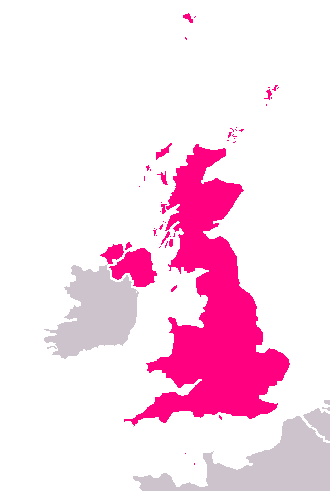
The United Kingdom of Great Britain and Northern Ireland, commonly known as the United Kingdom, the UK or Britain, is a sovereign state located off the northwestern coast of continental Europe. It is an island country, spanning the island of Great Britain, the northeast part of the island of Ireland, and many small islands. Northern Ireland is the only part of the UK with a land border, sharing it with the Republic of Ireland. Apart from this land border, the UK is surrounded by the Atlantic Ocean, the North Sea, the English Channel and the Irish Sea. The largest island, Great Britain, is linked to France by the Channel Tunnel.
The United Kingdom consists of England, Northern Ireland, Scotland and Wales. A unitary state with three devolved national legislatures, the UK is governed by a parliamentary system with its seat of government in London, the capital. The UK is a constitutional monarchy with Queen Elizabeth II as the head of state. The Crown Dependencies of the Channel Islands and the Isle of Man are Crown Dependencies and not part of the UK, but form a federacy with it. The UK has fourteen overseas territories, all remnants of the British Empire, which at its height encompassed almost a quarter of the world's land surface, the largest empire in history. British influence can continue to be observed in the language, culture and legal systems of many of its former colonies. Queen Elizabeth II remains the head of the Commonwealth of Nations and head of state of each of the Commonwealth realms.
The UK is a developed country, with the fifth (nominal GDP) or sixth (PPP) largest economy in the world. It was the world's first industrialised country and the world's foremost power during the 19th and early 20th centuries, but the economic cost of two world wars and the decline of its empire in the latter half of the 20th century diminished its leading role in global affairs. The UK nevertheless remains a major power with strong economic, cultural, military and political influence and is a nuclear power, with the second or third highest (depending on method of calculation) defence spending in the world.
Contents |
Government
The United Kingdom is a constitutional monarchy, with a parliamentary system of government.
Legislative
The British Parliament consists of the Queen, the House of Lords (unelected, consisting of hereritary peers, appointed peers, Lords Spiritual, and Law Lords), and the House of Commons (consisting of 646 Members of Parliament representing single-member constituencies in Great Britain and Northern Ireland).
The UK also has sub-national legislatures in Scotland (The Scottish Assembly), Wales (The Welsh Assembly), and Northern Ireland (The Northern Ireland Assembly) with devolved powers. There is a proposal for a devolved English Parliament.
Executive
Executive power in the United Kingdom is exercised on behalf of the Sovereign, in whom executive power is theoretically and nominally vested, by the UK government and the devolved Scottish Government, Welsh Assembly Government and the Northern Ireland Executive.
The Executive is led by the Queen who appoints a Prime Minister (who by convention is the member of the House of Commons able to command a majority), and several other Ministers of the Crown (on the advice of the Prime Minister). The Ministers are made members of Her Majesty's Most Honourable Privy Council, which consists of former, and present Ministers of the Crown as well as others, including the Law Lords.
Judiciary
The United Kingdom does not have a single legal system due to it being created by the political union of previously independent countries with the terms of the Treaty of Union guaranteeing the continued existence of Scotland's separate legal system. Today the UK has three distinct systems of law: English law, Northern Ireland law and Scots law.
The highest court in the UK is the Judicial Committee of the Privy Council (usually called 'The Privy Council')
Defence
See Main Article: British Armed Forces
The armed forces of the United Kingdom, commonly known as the British Armed Forces or Her Majesty's Armed Forces, and sometimes legally the Armed Forces of the Crown, encompasses a navy, an army, and an air force.
The United Kingdom has the second highest level of military spending in the world. Their Commander-in-Chief is the British monarch, HM Queen Elizabeth II and they are managed by the Defence Council of the Ministry of Defence. Consistent with longstanding constitutional convention, however, the Prime Minister holds de facto authority over the armed forces. Day to day management of the armed forces is the responsibility of the Secretary of State for Defence, Dr Liam Fox, MP.
The British Armed Forces consists of the following services:
Apart from these Armed Forces, the Ministry of Defence maintains several civilian agencies including:
- Ministry of Defence
- Royal Fleet Auxiliary
- Royal Maritime Auxiliary Service
- Ministry of Defence Police and Guarding Agency
- Ministry of Defence Police
- Ministry of Defence Guard Service
Politics
The two main UK parties are the left-leaning Labour Party, and the right-leaning Conservative Party (Tory Party). These parties control between them virtually all of the national level poltics in England, Scotland, and Wales. The third national party is the Liberal Democratic Party. Scotland and Wales have nationalist parties seeking secession from the UK, or dissoluton of the Union altogether.
No Great Britain-based parties have been able to maintain significant influence in Northern Ireland. North Irish political parties are generally centred around attitudes to Northern Ireland being within the United Kingdom.
Unionist parties (seeking to remain within the UK) include the Democratic Unionist Party (DUP), the Ulster Unionist Party (UUP), and other smaller parties such as the Progressive Unionist Party and the United Kingdom Unionist Party. The DUP is the dominant party, and in the past its Westminster MP's have sat with the Tories.
Republican parties (seeking a single Ireland) include Provisional Sinn Féin and the Social Democratic and Labour Party (SDLP).The SDLP is currently the dominant Republican party in Northern Ireland.
Foreign Relations
Britain's closest relationships are with the Commonwealth, and with the Federated States of America. In Europe, Britain has maintained the same foreign policy goal for over 900 years, to keep Europe disunited. There has been at times a Euro-federalist movement, however this movement has never gained significant support, and it must be noted that the two powers most likely to unite Europe are Fascist Germany, and the Soviet Union. Britain's allies in Europe consist of states like France, and some states in Eastern Europe.
Economy
Britain has a highly diversified economy. It is the second largest economy in Europe, and the fifth largest in the world. Britain was the world's first industrialised country, and in the nineteenth century Britain created a vast overseas market for British goods. That market has declined somewhat with the industrialisation of other nations. Manufacturing is about 20 percent of the UK's economy. Britain is a prominent defence manufacturer.
The service industry in the UK is massive, and highly prosperous, ranging from hospitality through to financial and legal services. The City of London is the financial capital of the world, and along with New York and Tokyo, one of the command centres of the world economy. Edinburgh is gaining a reputation as a centre of world finance.
Tourism is an important sector of the British economy. 27 million tourists arrived in Britain in 2004.
Agriculture accounts for less than one percent of the UK's gross product, and less than three percent of employment, though London has a highly active agricultural futures market. Most British food is imported from the Third World, and the Commonwealth.
Energy is a significant sector of the British economy. The UK makes extensive use of nuclear power, and has significant reserves of oil and natural gas.
HM Treasury is the agent of government intervention in the economy, with the Bank of England responsible for monetary policy. The Treasury has maintained a low-tax, low-regulation policy since 2001, and the Bank has kept inflation to less than 1.7%. This has given Britain seven years of good growth, of between 3 and 5 percent.
The currency of the UK is the pound sterling, represented by the symbol £. The Bank of England is the central bank, responsible for issuing currency. Banks in Scotland and Northern Ireland retain the right to issue their own notes, subject to retaining enough Bank of England notes in reserve to cover the issue.
