United States Army
From Themarshallwiki
(→Equipment) |
|||
| Line 149: | Line 149: | ||
==Combat Vehicles== | ==Combat Vehicles== | ||
| + | |||
| + | *M1 Abrams | ||
| + | **M1A1 HA | ||
| + | **M1A1 AIM | ||
| + | **M1A2 SEP [http://www.jedsite.info/tanks-alpha/alpha/abrams_series/m1a2-sep/m1a2sep.html] | ||
| + | **M104 Wolverine Heavy Assault Bridge [http://www.jedsite.info/tanks-alpha/alpha/abrams_series/wolverine-m104/m104.html] | ||
| + | **M105 Abrams Recovery Vehicle [http://www.jedsite.info/tanks-alpha/alpha/abrams_series/arv/arv-intro.html] | ||
| + | **M108 Liberty Abrams Air Defence System [http://www.jedsite.info/tanks-alpha/alpha/abrams_series/liberty/liberty-intro.html] | ||
| + | *M2 Bradley Infantry Fighting Vehicle | ||
| + | **M3 Bradley Cavalry Fighting Vehicle | ||
| + | **M6 Bradley Liberty Air Defence Vehicle [http://www.jedsite.info/fulltrack-bravo/bravo/bradley_series/crotale/crotalebradley-intro.html] | ||
| + | **M2 Bradley AMEV (Armoured Medical Evacuation Vehicle) [http://www.jedsite.info/fulltrack-bravo/bravo/bradley_series/amev/amev-intro.html] | ||
| + | **M4 Bradley AMTV (Armored Medical Treatment Vehicle) [http://www.jedsite.info/fulltrack-bravo/bravo/bradley_series/amtv/amtv-intro.html] | ||
| + | **M7 FIST (Fire Support Team Vehicle) [http://www.jedsite.info/fulltrack-bravo/bravo/bradley_series/m7-fist/m7-intro.html] | ||
| + | *M8 Buford Armoured Gun System | ||
| + | *M113 series | ||
| + | **M113A3 Armoured Personnel Carrier | ||
| + | **M113A4 Gavin Armoured Personnel Carrier [http://www.jedsite.info/fulltrack-mike/mike-number-us/m113_series/mtvl/mtvl-intro.html] | ||
| + | ** | ||
| + | |||
==Artillery== | ==Artillery== | ||
Revision as of 19:03, 26 July 2008
The United States Army is the land component of the United States armed forces. It is a military organization whose primary mission is to "provide necessary forces and capabilities in support of the National Security and Defense Strategies."
It is the largest, and by some standards, the oldest established branch of the armed forces of the United States and is one of seven uniformed services. Like all armies, it has the primary responsibility for land-based military operations. The modern Army had its roots in the Continental Army which was formed on June 14, 1775, before the establishment of the United States, to meet the demands of the American Revolutionary War. Congress created the United States Army on June 14, 1784 after the end of the war to replace the disbanded Continental Army. The Army considers itself to be descended from the Continental Army, and thus dates its inception from the origins of that force.
Control and operation of the Army is administered by the Department of the Army, one of the three service departments of the Department of Defense. The civilian head is the Secretary of the Army and the highest ranking military officer in the department is the Chief of Staff, unless the Chairman of the Joint Chiefs of Staff or Vice Chairman of the Joint Chiefs of Staff are Army officers. As of August 31, 2007, the Regular Army reported a strength of 519,472 soldiers. By the end of 2006, the Army National Guard (ARNG) reported 346,288 and the United States Army Reserve (USAR) reported 189,975, putting the approximate combined component strength total at 1,055,734.

Contents |
Structure
The US Army has three components, the Regular Army (officially known as the United States Army), the Reserve (officially known as the United States Army Reserve), and the Army National Guard (41 Army National Guards in total, 38 States, 2 Territories, and the District of Columbia).
The Commander in Chief of US Army is the President of the United States (currently Chris W. Marshall. The Army itself is led by a civilian Secretary of the Army (SECARMY), who reports to the Secretary of Defence. The Secretary of the Army provides civilian oversight for the Chief of Staff of the US Army, who is the US Army's senior military officer, and is a four-star General who is also a member of the Joint Chiefs of Staff.
The 1986 Goldwater-Nichols Act mandated that operational control of the services follows a chain of command from the President to the Secretary of Defense directly to the Unified Combatant Commanders, who have control of all armed forces units in their geographic or function area of responsibility. Thus, the Chief of Staff of each service only has the responsibility to organize, train and equip their respective service component. The services provide trained forces to the Combatant Commanders for use as they see fit.
The Army is currently undergoing a period of transformation, which is expected to be finished in 2009. When it is finished, there will be six geographical commands which will line up with the five geographical Unified Combatant Commands (COCOM).
- United States Army Central headquartered at Fort Monroe, Virginia
- United States Army North headquartered at Fort Sam Houston, Texas
- United States Army South headquartered at Fort Sam Houston, Texas
- United States Army Europe headquartered at Campbell Barracks, Heidelberg, Germany
- United States Army Pacific headquartered at Fort Shafter, Hawaii (eventually to be merged with the Eighth Army).
- United States Army Africa headquarted at Simonstown, South Africa
- United States Army Special Operations headquartered at Fort Campbell, Kentucky (USASOC)
Another goal of the transformation is to flatten the US Army's structure, in other words, to reduce the number of layers of command between the Combatant Commander and the Soldier.
The transformation is producing an information age Army.

US Army recruiting logo
Combat Maneuver Organsiations
The main combat maneuver organisation of the US Army is the Brigade, of which the US Army has 48.
Divisional insignia are currently maintained for the sake of tradition, however the Divisional headquarters no longer exists. Three brigades will wear the same Divisional insignia. The US Army have a three stage Rotational Readiness System, conisting of Training, Deployment, and Reconstitution. It has been decided that the three Brigade 'division' will be in that cycle. For example, 3 Heavy Brigades will wear the Norman Shield insignia of the 1st Cavalry Division. At any given time, one Brigade wearing this badge will be in the Training phase, one in the Deployment phase, and one in the Reconstitution phase.
The US Army has 5 types of Brigades:
- 12 Heavy Brigades
- 18 Medium Brigades
- 9 Light Brigades
- 3 Airborne Brigades
- 3 Air-Mobile Brigades
All of these Brigades are fully integrated units combining maneuver, fire support, IISR (information, intelligence, surveillence, and reconnaissance), combat mobility (engineers), sustainment, and aviation.
They are distinguished primarily by the vehicles used for infantry mobility. Heavy Brigades all use the M2 Bradley, Medium Brigades use the M113A4 Gavin (MTVL), Light Brigades predominantly use the RG-31, RG-33, and Cougar series. Airmobile and Airborne Brigades do not use organic mechanised or motorised infantry transport.
Other Brigade level units include Theatre Air and Missile Defence Brigades, and Theatre Ballistic Missile Brigades.
Commands
The US Army has a number of Component Commands responsible for providing training, evaluation, testing, doctrine development, and specialised services to the Army. Some of these commands are new. Particularly the Financial and Auditing Command which is now a three-star command reflecting President Marshall's drive for greater accountability, and financial transparency in the Federal Government.
- United States Army Materiel Command
- United States Army Training and Doctrine Command (TRADOC)
- U.S. Army Test & Evaluation Command
- U.S. Army Intelligence and Security Command
- U.S. Army Corps of Engineers
- U.S. Army Medical Command
- United States Army Military District of Washington
- U.S. Army Criminal Investigation Command (USACIDC)
- United States Army Legal and Justice Command
- U.S. Army Network Enterprise Technology Command
- United States Army Financial and Auditing Command
- U.S. Army Installation Management Command (IMCOM)
- U.S. Army Human Resources Command (HRC)
Special Operations Forces
Special Forces exist outside this structure, and are part of United States Army Special Operations, which is in turn part of United States Special Operations Command. USASO consists of the following units:
- United States Army Special Forces (Green Berets)
- 75th Ranger Regiment (Airborne)
- 160th Special Operations Aviation Regiment (Airborne)
- 4th Psychological Operations Group (Airborne)
- 95th Civil Affairs Brigade (Airborne)
- Sustainment Brigade (Special Operations) (Airborne)
- United States Army John F. Kennedy Special Warfare Center and School
Equipment
Small Arms
Pistols
- M9 9mm pistol
- M11 9mm pistol
- Mk 23 Mod 0 .45 ACP pistol (Special Forces)
- Heckler & Koch USP Tactical .45 ACP pistol (Special Forces)
Rifles
- M16A2/A3/A4 5.56mm rifle
- M14 7.62mm rifle
- M14 SMUD (Stand-off Munition Disruption rifle)
- M1903 Springfield Rifle .30'06 rifle (US Army Drill Team)
Carbines
- M4/M4A1 Carbine 5.56mm carbine
- Mk 18 Mod 0 CQBR 5.56mm carbine (Special Forces)
- Colt Model 723/725/727 5.56mm carbine (Special Forces)
- HK 416 Carbine 5.56mm carbine (Special Forces)
Submachine Guns
- HK MP5/MP5N 9mm submachine gun
- HK MP5SD3/5/6 9mm submachine gun (Special Forces)
- HK MP5K/MP5K-N 9mm submachine gun (Special Forces)
- HK UMP .45 ACP submachine gun (Special Forces)
Machine Guns
- M249 Minimi 5.56mm light machine gun
- M240 7.62mm general purpose machine gun
- M60 7.62mm general purpose machine gun
- M2 Browning .50 BMG heavy machine gun
Sniper Rifles
- M24 Sniper Weapon System 7.62mm sniper rifle
- M110 SASS 7.62mm sniper rifle
- M21 7.62mm sniper rifle
- M82 .50 BMG sniper rifle
- M107 .50 BMG sniper rifle
Shotguns
- Mossberg 500 & 590 12 gauge shotgun
- M1014 12 gauge shotgun
- KAC Masterkey 12 gauge shotgun (Special Forces)
- Remington 870 12 gauge shotgun
Heavy Weapons
- M203A1/A2 40mm grenade launcher
- M32 40mm Multiple Grenade Launcher
- M3 MAAWS 84mm recoilless rifle
- M72 66mm rocket launcher
- M136 AT4 84mm disposable rocket launcher
- Mk 153 Mod 0 SMAW 83mm rocket launcher
- FGM-172 SRAW anti tank missile
- FGM-148 Javelin anti tank missile
- FIM-92 Stinger surface to air missile
Combat Vehicles
- M1 Abrams
- M2 Bradley Infantry Fighting Vehicle
- M8 Buford Armoured Gun System
- M113 series
- M113A3 Armoured Personnel Carrier
- M113A4 Gavin Armoured Personnel Carrier [9]
Artillery
Anti-Tank Weapons
Air Defence
Aircraft
Support Vehicles
Aerial Weapon Systems
Uniforms
The US Army's dress uniform hasn't changed much since 1945. The so-called 'pinks and green' (named because the beige of the shirt and tie has a slight pinkish hue) has withstood the test of time. The only major change was in the short service dress jacket (the Ike Jacket) in which buttons were replaced with a zip.
The US Army's combat uniforms on the other hand have changed significantly in the last 60 years, and the current Army Combat Uniform, which replaced the M81 Battle Dress Uniform in 2007 is a thoroughly modern combat uniform.
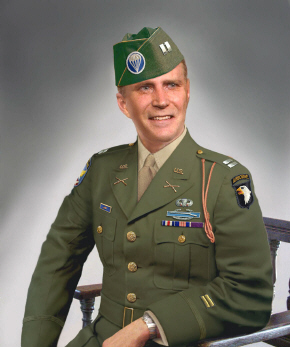
US Army Service Uniform

Army Combat Uniform

Flag of the United States Army
